Abstract
This mini-essay explores the function and aerodynamic principles behind Formula 1 diffusers. Positioned at the rear of the vehicle, the diffuser plays a crucial role in managing the airflow that passes underneath the car. As this airflow is accelerated through the floor, it reaches the diffuser, where the geometry expands to transition the low-pressure, high-speed flow back to atmospheric pressure. Using Bernoulli’s principle, the essay explains how pressure differentials between the upper and lower surfaces of the car generate downforce. Moreover, the three-dimensional behavior of the flow in the diffuser region introduces vorticity, which helps energize the boundary layer, delay flow separation, and enhance pressure recovery. These vortices not only boost downforce but also prevent unwanted ambient flow from entering the underfloor. As the diffuser can contribute up to 50% of a Formula 1 car’s downforce with minimal drag, it remains one of the most critical components in modern aerodynamic design.
Keywords
Downforce
Vertical aerodynamic force that pushes the car toward the ground, improving the grid and vehicle stability at high speeds. Generated by pressure differences between the upper and the lower surfaces of the car.
Aerodynamic component
An aerodynamic component is any physical part of the vehicle designed to specifically influence the airflow around it in order to modify the aerodynamic forces acting on the car—namely downforce, drag, or lift.
Bernoulli’s principle
A principle from fluid dynamics stating that in incompressible, inviscid flow, an increase in velocity leads to a decrease in static pressure. This principle helps explain how faster airflow beneath the car results in lower pressure and hence downforce.
Suction
In this context, suctions refers to the low-pressure region under the car that pulls the vehicle downward.
Pressure gradient
The rate and direction of change in pressure across a flow field, the pressure gradients is what helps to generate movement. Normally pressure goes from high to low, when the contrary, we can say we have an “adverse pressure gradient (when pressure goes from low to high)”, and this can cause deceleration and flow separation, but can be counteracted by high momentum or vortex energy.
Boundary layer
The thin layer of fluid near a solid surface where viscous effects are significant. Here, flow separation often begins, especially under adverse pressure gradient; however, energizing the boundary layer helps keep the flow attached to the surface.
Flow separation
The thin layer of fluid near a solid surface where viscous effects are significant. Here, flow separation often begins, especially under adverse pressure gradient; however, energizing the boundary layer helps keep the flow attached to the surface.
Vorticity
A measure of local rotation in a fluid. In diffusers, vortices due to flow separation.
How does a Formula One diffuser work?
The diffuser is an aerodynamic component located at the rear of the vehicle, its primary function is to release the air that has been sped up through the floor of the vehicle and to generate the suction underneath the car to create downforce [1]. This downforce is crucial as it enhances the grip of the car on the road, allowing faster cornering and braking speeds.
Therefore, from the statement said above, we can now see that diffusers have the role of transitioning the high velocity—lower pressure air under the car, traveling through the floor—to the high-pressure levels surrounding the car, making that pressure to reach atmospheric levels [2].

Bernoulli’s Principle
The Bernoulli’s principle states that, for a fluid at motion, if airspeed varies as it flows around an object, then the pressure will change in an inverse proportion to the square of the airspeed—in other words, as the air flows faster around the vehicle, the pressure will be reduced [4].
Therefore, when a Formula One car is racing, air will travel throughout the whole vehicle, but especially two paths will be created, one will be the path that travels above the car, and the other will be the air that travels beneath the vehicle through the floor (see figure 2). The upper air will face more complex and drag generating geometries (e.g. front wings, sidepods, cooling intakes); meanwhile, the lower flow will go through the floor and will have a much faster velocity. The difference in velocities will generate a pressure difference, being higher above the car and extremely low beneath it contributing to downforce as the the car will be pushed down due to the higher pressure acting normal to the fluid flow.
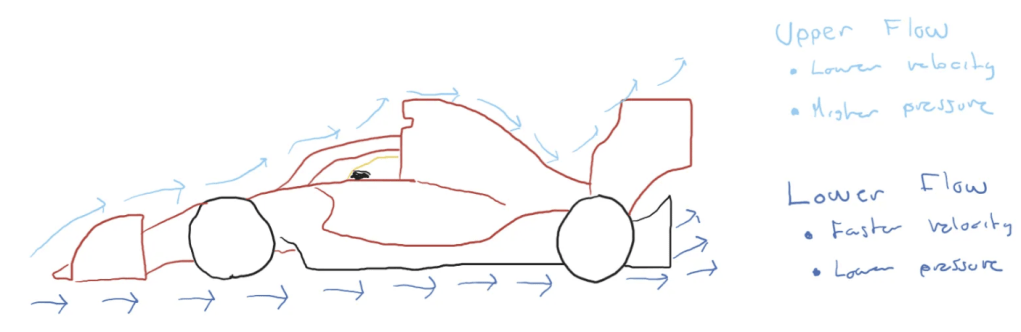
So now, diffusers redirects the fast-moving air under the car upwards and outwards, expanding or diffusing it into the slower and high-pressure air above and outside [2]. To explain it better we can return to figure 1, P_{in}—flowing through the floor—is lower than the atmospheric pressure of the environment, and, as the flow goes further, it will reach the diffuser; here we see how the geometry expands, and this expansion will create a pressure gradient going from lower to higher pressure.
Vorticity
However, in figure 1 we see a 2D diagram, but real life happens in 3D. As the flow enters to the diffuser region and expands, vortices will be generated due to the separation from the surface creating a region of low pressure near the trailing edge [3]. The vortices will roll up along the lower edge of the diffuser and they will be driven by the pressure gradient between the high-pressure region above and the low pressure region below. However, these vortices energizes the boundary layer, accelerating the streamwise diffuser flow and, subsequently, enhancing suction which leads to an improvement in downforce [5].
It is relevant to mention, that this vortices—and the vortices generated by other aerodynamic components in the vehicle—help to avoid external flow to get inside the floor and into the diffuser (because as we remember, the low pressure is generating a suction from every direction) as this would decrease the performance.
Conclusion
The floor and the diffuser of a Formula One vehicle may represent the most important aerodynamic components, in difference with front and rear wings, the diffuser creates a significant aerodynamic downforce and relatively low drag production. This component produces around 50% of the total downforce generated [5]; so many teams invest a lot of effort on designing the best one. Just as the team Brawn GP did in 2009, winning the constructors and drivers championships.
So, in summary, diffusers accelerate the flow under the Formula One vehicle increasing downforce. It works through Bernoulli’s principle that creates low pressure through the flat floor, as the flow reaches the diffuser, the geometry expands, this expansion will cause the flow to separate from the surface leading to the generation of vortices; however, these vortices help to energize the boundary layer, accelerating the flow as well and causing an enhancement in suction and a smooth pressure recovery from low to atmospheric.
Sources of information
[1] Aerodynamics Analysis of Formula One Vehicles – Atsushi Ogawa.
[2] What is a diffuser in Formula One? – Sophia Richmond
[3] Wilem Toet explains… motorsports diffusers – Willem Toet
[4] Race Car Aerodynamics: Designing for Speed – Joseph Katz
[5] A review of ground-effect diffuser aerodynamics – Kevin Knowles
 Sebas Bravo